Q1. Which of the following quantity remains constant during the uniform circular motion?
Q2. The velocity time graph will be a straight line with a non-zero slope for the motion of a ball which is launched vertically up and then comes back down under the influence of gravitational acceleration. Choose the correct option
Q3. Rain falls at a speed of 50m/s and a child walks on a straight road from east to west at a speed of 100m/s. To find the direction in which the child should hold the umbrella use
Q4. A coordinate system that enables us to describe the position of a body in space at any instant of time is called
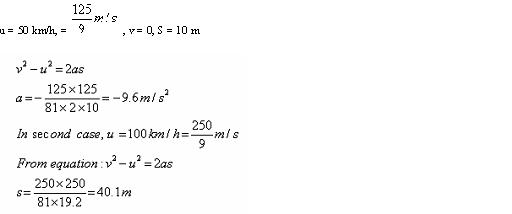
Q5. A car moving with a speed of 50 km/h can be stopped by applying brakes after at least 10 m. What will the minimum stopping distance if the same car is moving at a speed of 100 km/h?
Q6. If the path length covered by a body is zero then
Q7. What does the slope of x-t graph represent?
Q8. Which of the following quantity remains constant during the uniform circular motion?
Q9. The ratio of displacement to distance is
Q10. A bullet fired into a fixed target loses half of its velocity after penetrating 3 cm. What will be its acceleration?
.jpg)
Q11. Two stones of different masses are thrown vertically upward with same initial velocity. Which one will rise to a greater height?
Q12. On velocity-time graph, a horizontal line indicates:
Q13. A body is said to have uniform speed if it covers
Q14. The position of a particle is given by x = at3 where a is a constant. Find the velocity as a function of time.
Q15. The area of acceleration time graph indicates:
Q16. A ball is thrown vertically upward. At the highest point in its path, which of the following statements is correct?
Q17. The motion of a freely falling body is an example of:
Q18. If a particle is moving in a spiral path with constant speed, then:
Q19. On acceleration-time graph the area under the curve equals the:
Q20. The kinematic equation of motion v = u+at is not applicable if :
Q21. What does the slope of a velocity - time represent?
Q22. The speed of an object in a particular direction is called
Q23. Which of the following measurements could be a velocity?
Q24. A body of mass 1kg and 10kg are dropped simultaneously from the top of a tower. The ratio of the time taken by them to reach the ground is
Q25. The acceleration at any instant is the slope of the tangent of the _______curve at that instant:
Q26. What is the distance of the star (in km) from which a light takes 3 x 10⁹ year to reach the earth? The speed of light, is C = 3 x 10⁸ m/s.
Q27. The magnitude of displacement is equal to minimum possible distance between two positions.
Q28. The slope of velocity-time graph gives:
Q29. On velocity-time graph when two curves coincide, the objects will have
Q30. A boy throws up a ball in a stationary lift and the ball returns to his hands in 10 s. Now if the lift starts moving up at a speed of 5 m/s. The time taken for a ball thrown straight up to return to his hands is:
Q31. Choose the incorrect statement
Q32. If in case of a motion, displacement is directly proportional to the square of time elapsed, what do you think about its (A) velocity (B) acceleration?
 So velocity varies linearly with time and acceleration is a constant.
Q33. If the signs of the velocity and acceleration of a particle are the same, the speed of the particle ______________.
Q34. If a body does not change its direction during the course of its motion, then
Q35. Which of the following statements about distance is true:
Q36. A car moving with a speed of 50 km/h can be stopped by applying brakes after at least 10 m. At what rate the velocity is decreasing in the motion?

Q37. The displacement of a particle starting from rest (at t = 0) is given by s = 6t2-t3 The time in seconds at which the particle will attain zero velocity again, is
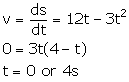 Here t = 0 is not realistic so at t = 4s the velocity will be zero.
Q38. A particle is moving along a circle of radius R such that it completes one revolution in 40 seconds. What will be the displacement after 2 minutes 20 seconds?
.gif)
Q39. For uniform circular motion:
Q40. Two stones of different masses are thrown vertically upward with same initial velocity. Which one will rise to a greater height?
Comments
Post a Comment