Q1. A body of mass 5 kg revolves in a circle of diameter 0.60m, making 1000 revolution per minute. Then, the linear velocity of body is:

Q2. A rifle shoots a bullet horizontally at a speed v=200 m/s. At the same time, a bullet is dropped from the same height as the bullet that left the rifle. Ignoring all effects due to air resistance, which bullet reaches the ground first?
Q3. If an object is dropped through the window of a fast running train. Then
Q4. Two vectors are equal if and only if
Q5. The dot product of mutually perpendicular vectors is always:

Q6. If the magnitude of two vectors is 4 and 5 and the value of their scalar product is 10, then the angle between vectors is:

Q7. If a projectile is thrown with a velocity 10 ms-1 at an angle of 300 with the horizontal. Then the time of flight will be
.gif)
Q8. A body is thrown with a velocity of 10 m/s at an angle of 60 degrees with the horizontal. Its velocity at the highest point is:
Q9. The distance travelled by an object along the axes are given by x = 2t2 ,y = t2-4t, z = 3t - 5 . The initial velocity of the particle is
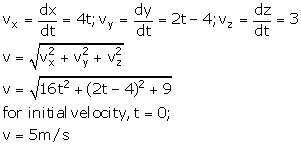
Q10. A body of mass 15 kg revolves in a circle of diameter 1.20m, making 100 revolution per minute. Then, the linear velocity of body is:
.gif)
Q11. The vector product of parallel vectors is always:

Q12. The quantity which remains unchanged during the flight of an oblique projectile is
Q13. Magnitude of resultant of two vectors, A and B is given by square root of:
Q14. A cart moves with a constant speed along a horizontal circular path. From the cart, a particle is thrown up vertically with respect to the cart, the particle will,
Q15. Which one of the following is not an example of projectile?
Q16. A force of 20 N acts on a body and displaces it 2m along the direction of force. Then the work done by the force is:
Q17. Find the odd one out:
Q18. The angular speed of a flywheel making 210 revolutions per minute is:

Q19. At the top point of a projectile, angle between the directions of its velocity and acceleration is

Q20. At what angle should a projectile with initial velocity 'v' be thrown, so that it achieves its maximum range?
 )/2g = (u2)/2g, implying the angle should be equal to 45°..
Q21. Which statement is true for a ball thrown at 20 degrees with the horizontal, when it is at the highest point in its trajectory?
Q22. At maximum height during the journey of a projectile, which quantity becomes zero?
Q23. Which of the following is the vector quantity?
Q24. A tennis ball bounces higher on hills than on planes. Which statement gives the correct reason-
 and g is less on hills.
Q25. The angular speed of a wheel of radius 0.50 m moving with the speed of 20 m/s is:

Q26. If velocity of P with respect to Q is 40 km/h, then velocity of Q with respect to P is

Q27. A vector A points towards east and vector B points north then A x B points
Q28. Two forces, whose magnitude are at the ratio of 3:5 give a resultant of 35 N. If angle of inclination is 60o, then the magnitude of each force is:
 35 N =
  After solving above equation, we get:
x = 5 and two forces are: 15N and 25N respectively.
After solving above equation, we get:
x = 5 and two forces are: 15N and 25N respectively.
Q29. The angular speed of a wheel of radius 0.50 m moving with the speed of 20 m/s is:

Q30. A monkey is running on the ground, next to a train, in the direction of the train. The speed of the monkey is 5km/h and the speed of the train is 100km/h. What is the velocity of the monkey with respect to the train?
Comments
Post a Comment