Q1. If we apply Newton's First Law to torque then the statement will be
Q2. A ring is rolling on a horizontal surface without slipping. Find the ratio of translation K.E. to rotational K.E. of ring.

Q3. Two bodies of masses m1 and m2 are moving such that their momentums are equal and opposite. The velocity of centre of mass of system of two bodies is:

Q4. A smooth sphere A is moving on a frictionless horizontal plane with angular speed ω and center of mass velocity v. It collides elastically and head on with an identical sphere B at rest. Neglect friction everywhere. After the collision, their angular speeds are ωA and ωB respectively. Then
Q5. A stick is thrown in the air and lands on the ground at same distance from the thrower. The centre of mass of the stick will move along a parabolic path
Q6. A rigid body is said to be in mechanical equilibrium if

Q7. Angular momentum is equal to____.(All the symbols used have their usual meanings)
Q8. Which of the following is not a binary system?
Q9. Vectorially, angular velocity of a rotating body is represented :
Q10. What is the relation between rad/s 2 and r p s 2 ?
Q11. A body is moving with constant velocity parallel to x axis. Its angular momentum w.r.t origin will
Q12. The moment of inertia of a body is independent of
Q13. A boy is playing with a tire of radius 0.5m. He accelerates it from 5rpm to 25 rpm in 15 seconds. The linear acceleration of tire is

Q14. Which of the following doesn't use the application of Conservation of Angular Momentum?
Q15. A pair of equal and opposite forces with different line of action are said to form a
Q16. The motion of centre of mass of a system of two particles is unaffected by their internal forces
Q17. A circus acrobat while performing spins brings his limbs closer to the body. Due to this
Q18. The centre of mass of a body is located
Q19. A proton and an electron, initially at rest, are allowed to move under their mutal attractive force. Their centre of mass will:
Q20. A man standing on a table rotating about the central axis pulls his hands holding the dumb bells towards chest. How the angular velocity will change?
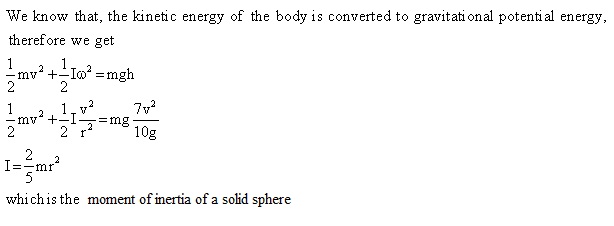
Q21. An iron made, regular shaped body moves with an initial velocity of “v” on an inclined plane. It reaches to a maximum height of 7 v 2/10 g.What is the geometrical shape of the body?
Q22. There are some passengers inside a stationary railway compartment. The centre of masses of the compartment itself(without the passengers) is C1, while the centre of mass of the compartment plus passengers' system is C2. if the passengers moves about inside the compartment
Q23. The angular momentum of a system of particles is not conserved when
Q24. A car decelerates uniformly from velocity v1 to velocity v2 while getting displaced by s. If the diameter of the wheel is d, the angular acceleration of the wheel is
 of the wheel is given by
 =a/r where r is the radius of the wheel (which is equal to d/2).
Therefore,
=a/r where r is the radius of the wheel (which is equal to d/2).
Therefore, 
Q25. The moment of momentum is known as
Q26. A body is rolling down an inclined plane without slipping. How does the acceleration of the rolling body depend on its radius?
Q27. Two identical particles move towards each other with velocity 2v and v respectively. The velocity of the centre of mass is


Q28. Two rings have their moment of inertia in the ratio 2:1 and their diameters are in the ratio 2:1. The ratio of their masses will be:

Q29. To maximize torque on a lever, which of the following will not help?

Q30. The motion of a potter's wheel is an example of
Q31. Which of the following is not an example of couple?
Q32. All the points of a rigid body rotating about the given axis have same :
Q33. The sum of moments of masses of all the particles in a system about the centre of mass is always:
Q34. The centre of mass of a system of particles does not depend on
Q35. If the resultant of all external forces is zero, then velocity of centre of mass will be
Q36. There are two circular iron discs A and B having masses in the ratio 1:2 and diameter in the ratio 2:1. The ratio of their moment of inertia is

Q37. Four billiards balls, each of mass 0.5 kg, all are travelling in the same direction on a billiard table, with speeds of 2 m/s, 4 m/s, 8 m/s and 10 m/s. What is the linear momentum of this system?
Q38. The SI unit of centre of mass is
Q39. Moment of inertia of a solid sphere of mass M and radius R is ______
Q40. The dimensional formula for the torque is
Comments
Post a Comment